
Quick answer: IPTV itself is legal in Canada. Bell Fibe TV, Telus Optik TV, Rogers Ignite TV, Sportsnet+ and CBC Gem are all IPTV, and nobody questions them. What the law targets is unlicensed content: the Copyright Act makes it an infringement to provide a service primarily built to enable infringement, and Canadian courts have ordered ISPs to block pirate IPTV platforms since 2019. Canadian enforcement has focused on operators and resellers, not on households, but subscribing to an unlicensed service is not lawful and carries real civil exposure.
Search “is IPTV legal in Canada” and you get two opposite answers on the same results page: forum posts insisting that “watching is never illegal” and headlines about Federal Court blocking orders. Both are half right, because the question mixes up a delivery technology with the content delivered over it. This guide separates the two, walks through the relevant sections of the Copyright Act, summarizes the major Canadian court decisions on pirate streaming, and ends with a checklist you can apply to any service, including ours. Nothing here is legal advice; where we give an opinion we label it “our view”.
Is IPTV legal in Canada? The short answer
Yes, with a condition. IPTV (Internet Protocol Television) is television delivered as data packets over an IP network instead of a cable, satellite or antenna signal. No Canadian law restricts that delivery method: Bell, Telus and Rogers all use IPTV for their flagship TV products, and the CRTC (Canadian Radio-television and Telecommunications Commission) has exempted internet-delivered programming from licensing since 1999.
The condition is licensing. A service that streams channels or on-demand libraries without the rights holders’ permission infringes copyright under section 27 of the Copyright Act, and since 2012 the Act has had a provision aimed squarely at online services whose main purpose is enabling infringement. So the honest answer to “is IPTV illegal in Canada” is: the technology is not, but many of the cheap “every channel on earth” services sold on social media are, and the courts treat them that way.
What is IPTV, and why is the technology itself lawful?
IPTV sends video over the same Internet Protocol that carries email and web pages. The provider encodes each channel, hosts it on servers and streams it to an app on your TV, phone or set-top box over any broadband connection. For a deeper technical explanation, our guide to how IPTV works in Canada covers architecture, streaming formats and bandwidth.
Three terms come up constantly. An EPG (Electronic Program Guide) is the on-screen channel schedule. An M3U playlist is a text file listing stream addresses so a player app can load them. Xtream Codes is a login format (server address, username, password) many apps use to connect to an IPTV server. None is illegal on its own; they are formats and protocols used by hobbyists and commercial providers alike.
This is the point that matters legally. The Copyright Act regulates acts (copying, communicating to the public, making available) and the services that enable them, not protocols. A Fire TV Stick, an Android box or an M3U player app is lawful. The legal analysis begins when you ask what content flows through it and whether the people streaming it had the right to do so.
What does the Copyright Act say about streaming, pirated content and set-top boxes?
The Copyright Act (R.S.C., 1985, c. C-42) is federal law, so the rules are the same in every province. The consolidated text on the Department of Justice site was current to September 30, 2026 when we checked it. Four parts of the Act do most of the work in IPTV cases.
Section 27(1): the general infringement rule
Section 27(1) says it is an infringement for anyone to do, without the owner’s consent, anything only the owner has the right to do. For television that includes communicating a work to the public by telecommunication and making it available online. A pirate operator who captures Sportsnet, TSN, RDS or HBO and re-streams it to subscribers is doing exactly that, which is why rights holders can sue operators without any special “IPTV law”.
Section 27(2.3): the “enabler” provision
Added by the Copyright Modernization Act in 2012, section 27(2.3) makes it an infringement to provide, over the internet or another digital network, “a service primarily for the purpose of enabling acts of copyright infringement,” provided an actual infringement occurs through it. Section 27(2.4) lists the factors a court weighs: whether the service was marketed as a way to infringe, whether the operator knew it enabled significant infringement, whether it has significant non-infringing uses, whether the operator could have limited infringement, what benefits the operator received, and whether the service would be viable without infringement.
Read that list against a typical “every channel on earth for C$10 a month” advertisement and you can see why rights holders win these cases comfortably. The enabler provision is aimed at operators, resellers and add-on repositories, not at viewers, but it underpins every Canadian pirate IPTV judgment since 2016.
Section 38.1: statutory damages, commercial versus non-commercial
Rights holders do not have to prove actual losses; they can elect statutory damages under section 38.1. For commercial infringement the range is C$500 to C$20,000 per work. For non-commercial infringement by an individual it is C$100 to C$5,000 for all works combined in that proceeding, and the court must consider proportionality and hardship. Subsection 38.1(1.11) deems any infringement under the enabler provision commercial, so an operator faces the per-work range with no cap; a household viewer, if ever sued, would face the non-commercial range.
Sections 41.25 to 41.27: the notice-and-notice regime
Canada does not have the U.S. “notice and takedown” system. Under section 41.26, when a rights holder sends a compliant notice to your ISP identifying an IP address and an alleged infringement, the ISP must forward it to the subscriber “as soon as feasible” and keep identifying records for six months (one year if a lawsuit is started). The ISP does not reveal your identity to the rights holder; that requires a court order. An ISP that fails to forward notices faces statutory damages of C$5,000 to C$10,000.
Since the 2018 amendments, a notice may not include a demand for payment or a settlement offer. If an email forwarded by Bell, Rogers, Telus or Vidéotron asks you to pay a “fine,” it is not a valid Canadian notice; phishing campaigns imitate real ones, so log in to your ISP account directly rather than clicking links. A genuine notice is a warning, not a bill; a lawsuit would arrive as a court Statement of Claim, at which point you should consult a lawyer. In practice, notice-and-notice has been used far more against BitTorrent, where the uploading IP address is visible, than against IPTV viewers.
Section 42: criminal offences
Copyright infringement is normally a civil matter, but section 42 makes commercial-scale infringement a criminal offence. On indictment the maximum is a fine of up to C$1,000,000, five years’ imprisonment, or both; lower maximums apply on summary conviction. These charges are laid by police, usually the RCMP, and in the IPTV context have been reserved for people selling subscriptions and devices for profit, as the Halifax case described later shows.
| Copyright Act provision | Who it targets | What it does | Typical exposure |
|---|---|---|---|
| s. 27(1) | Anyone who copies or communicates without consent | General infringement rule | Civil suit, injunction, damages |
| s. 27(2.3)–(2.4) | Operators, resellers, add-on sites | “Enabler” liability for services built for infringement | Deemed commercial; C$500–C$20,000 per work |
| s. 38.1(1)(b) | Individuals, non-commercial | Statutory damages cap | C$100–C$5,000 total per proceeding |
| s. 41.25–41.26 | ISPs and subscribers | Notice-and-notice forwarding and record keeping | Warning email; no settlement demand allowed |
| s. 42 | Commercial-scale infringers | Criminal offence | Up to C$1,000,000 and/or 5 years (indictment) |
What have Canadian courts actually done about pirate IPTV?
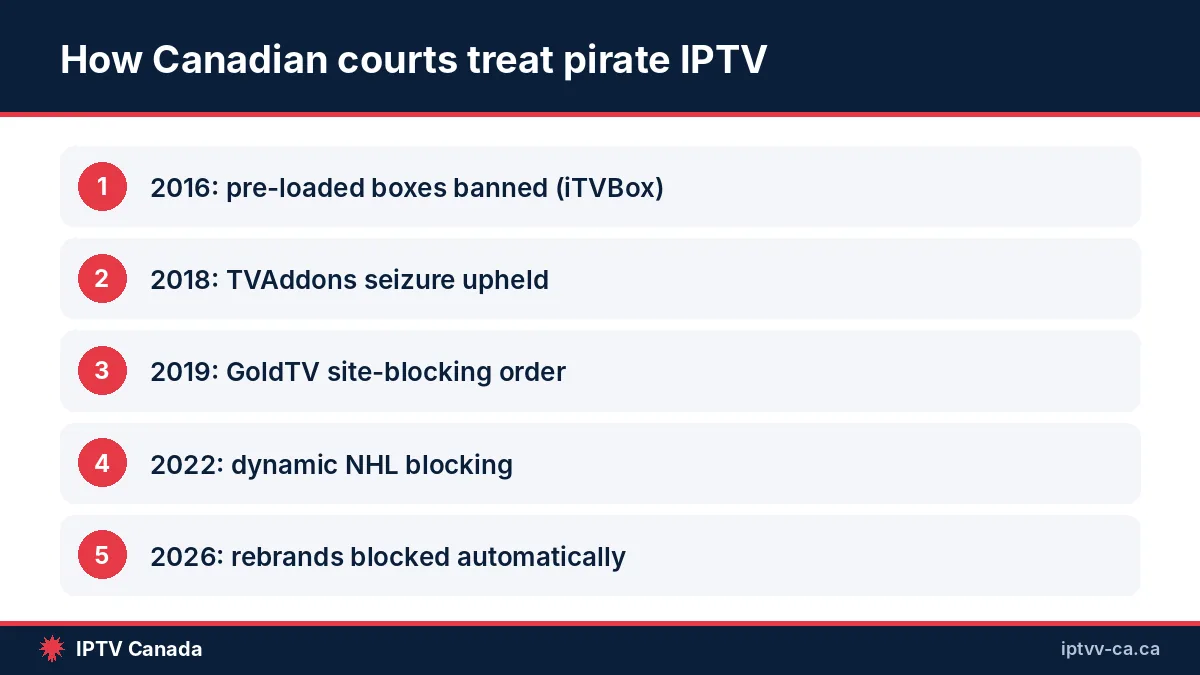
Canada’s case law on pirate streaming is a decade deep and follows a clear path: sellers of pre-loaded boxes first, then add-on repositories, then the pirate services themselves through ISP blocking, and most recently dynamic, open-ended blocking orders. Every one of these cases was a civil action brought by broadcasters and studios, not a prosecution of a viewer.
2016–2018: pre-loaded boxes and TVAddons
In Bell Canada v. 1326030 Ontario Inc. (iTVBox.net), 2016 FC 612, affirmed in 2017 FCA 55, the Federal Court enjoined retailers from marketing and selling set-top boxes pre-loaded with software configured to access pirated content; a 2018 contempt finding followed against one vendor who kept selling. Then in Bell Canada v. Lackman, 2018 FCA 42, the Federal Court of Appeal upheld an Anton Piller order (a civil search-and-seizure order) against the operator of TVAddons, a Kodi add-on repository, finding a strong prima facie case that distributing add-ons targeting copyrighted content infringed the making-available right, and rejecting the argument that the site was a neutral conduit.
2019–2021: GoldTV and Canada’s first site-blocking order
GoldTV was a pair of subscription IPTV services selling access to live and on-demand television owned by Bell Media, Groupe TVA (part of Québecor) and Rogers Media. The anonymous operators ignored injunctions, so in Bell Media Inc. v. GoldTV.Biz, 2019 FC 1432, the Federal Court for the first time ordered Canada’s major ISPs to block the GoldTV domains and IP addresses. TekSavvy, an independent ISP, appealed. In Teksavvy Solutions Inc. v. Bell Media Inc., 2021 FCA 100 (May 26, 2021), the Federal Court of Appeal unanimously dismissed the appeal on every ground: jurisdiction, the CRTC’s role, freedom of expression and whether the order was just and equitable. Site blocking has been settled law since.
2022: dynamic blocking of live NHL streams
Pirate sports streams change addresses during a single game, so a static domain list is too slow. In Rogers Media Inc. v. John Doe 1, 2022 FC 775, Justice Pentney granted the country’s first dynamic blocking order. A monitoring firm (Friend MTS) watches each Canadian NHL broadcast, identifies unauthorized live streams and feeds a regularly updated IP-address list to the ISPs, which block them during the game window. The Court found the safeguards against over-blocking adequate, any effect on freedom of expression proportionate, and capped ISP cost reimbursement at C$50,000.
2024–2026: NBA, Premier League and the “expanded scope” order
In July 2024 the Federal Court extended dynamic blocking beyond hockey. As The Wire Report described it, broadcasters holding Canadian rights to live NHL, NBA and Premier League games obtained an order requiring ISPs to block a rolling list of IP addresses tied to illegal live streams. Trade reporting since then describes further expansions to other sports properties; we could not confirm the exact list from primary sources, so treat the roster of leagues as evolving.
The most significant recent step came on July 3, 2026, in Federal Court file T-1127-26. According to Broadcast Dialogue, Groupe TVA, Rogers, Columbia Pictures, Disney, Netflix, Paramount, Universal and Warner Bros. obtained an order covering not only named pirate platforms but “similar platforms operating under other brands,” so that domains, subdomains and IP addresses can be added “without the need for a further motion or order.” When a blocked pirate service rebrands, rights holders no longer have to return to court, and with the Hollywood studios and Netflix now among the plaintiffs, on-demand libraries, not just live sports, are inside the blocking regime.
| Year | Case | Target | Outcome |
|---|---|---|---|
| 2016–2017 | Bell v. 1326030 Ontario (iTVBox), 2016 FC 612 / 2017 FCA 55 | Pre-loaded set-top box sellers | Injunction against marketing and sale; later contempt finding |
| 2018 | Bell Canada v. Lackman, 2018 FCA 42 | TVAddons Kodi repository | Anton Piller order upheld; strong prima facie infringement |
| 2019–2021 | Bell Media v. GoldTV, 2019 FC 1432 / Teksavvy v. Bell Media, 2021 FCA 100 | GoldTV pirate IPTV service | First ISP site-blocking order; affirmed on appeal |
| 2022 | Rogers Media v. John Doe 1, 2022 FC 775 | Live NHL pirate streams | First dynamic (real-time) blocking order |
| 2024 | Federal Court order (NHL, NBA, Premier League) | Live sports pirate streams | Rolling IP-address blocking across leagues |
| 2026 | Federal Court file T-1127-26 (July 3, 2026) | Named pirate platforms and rebrands | Blocking extends to similar platforms without new motion |
Has anyone in Canada been prosecuted or fined for watching IPTV?
We searched court databases, law-firm bulletins and news archives and found no reported Canadian case in which a person was prosecuted or ordered to pay damages solely for subscribing to and watching an unlicensed IPTV service. Every published IPTV enforcement action to date has targeted operators, resellers, box sellers or add-on distributors. That describes the record as of October 2026; it is not a guarantee about the future, and it is not the same as saying viewing is lawful.
What the record does show is criminal enforcement against sellers. In September 2020 the RCMP charged a Halifax-area couple and three companies with a combined 69 counts over the discounted resale of a telecom company’s programming over IP networks. As Global News reported, the charges included possession of property obtained by crime, distributing copyrighted material and laundering proceeds of crime. The article mentions no action against the couple’s customers.
On the civil side, the only mass actions against individual Canadians have involved BitTorrent, not IPTV. Film studios have used notice-and-notice records and Norwich orders to identify and sue BitTorrent users in the Federal Court, as CBC News reported in 2019. BitTorrent exposes your IP address to everyone in the swarm, while an IPTV viewer only connects to the pirate server. That explains the enforcement pattern, but the Copyright Act contains no “watching only” exemption, and a rights holder who obtained a pirate service’s subscriber database could, in principle, pursue non-commercial statutory damages.
Our view: the realistic risks for a Canadian household using an unlicensed service are not a knock on the door. They are the service disappearing mid-season after a blocking order, losing a prepaid year when the reseller vanishes, and handing payment details to an anonymous operator. Those are consumer-protection risks as much as legal ones, which is why the checklist below matters.
Which IPTV services in Canada are clearly legal?
Legal IPTV in Canada falls into three groups: the big distributors’ TV platforms, the broadcasters’ own apps, and licensed independent providers. The first two are easy to recognize because the company behind them is a household name. Our round-up of IPTV providers available in Canada and our overview of Canadian IPTV options compare them on devices and channels; the table below focuses on how you can tell each one is licensed.
| Service | Operator | What it is | How you know it is licensed |
|---|---|---|---|
| Bell Fibe TV | Bell Canada | IPTV over Bell fibre; app on Fire TV, Apple TV, Android TV | Licensed BDU (broadcasting distribution undertaking) |
| Telus Optik TV | Telus | IPTV in B.C., Alberta and parts of Québec | Licensed BDU |
| Rogers Ignite TV | Rogers | IPTV platform (Comcast X1-based) in Ontario, Atlantic and Western Canada | Licensed BDU; same operator that owns Sportsnet |
| Vidéotron Helix / Helix TV | Vidéotron (Québecor) | IPTV in Québec with full French lineup incl. TVA Sports | Licensed BDU; parent company is a GoldTV plaintiff |
| Sportsnet+ | Rogers Sports & Media | Direct streaming of national NHL games, MLB, more | Standard C$34.99/mo; Premium C$44.99/mo (from Sept. 22, 2026) |
| TSN+ / RDS | Bell Media | Direct streaming of TSN and French-language RDS | Bell Media holds the Canadian rights it streams |
| Crave | Bell Media | HBO, Max originals, Canadian series, films | Operates under the CRTC digital media exemption |
| CBC Gem | CBC/Radio-Canada | Free, ad-supported live CBC and on-demand; paid ad-free tier | Public broadcaster; CBC owns or licenses everything on it |
Hockey is the biggest reason Canadians go looking for alternative IPTV, so the Sportsnet+ numbers deserve a closer look. As iPhone in Canada reported, Sportsnet+ Premium rose to C$44.99 per month or C$344.99 per year from September 22, 2026, and Standard to C$34.99 per month or C$269.99 per year. Monday Night Hockey streams exclusively on Sportsnet+, with traditional TV subscribers paying a C$12.99 monthly add-on. Regional games, French-language coverage on TVA Sports and RDS, and national packages on other platforms are separate purchases. Legality does not make these services cheap; what it guarantees is continuity. Sportsnet+ will not vanish in the second period of a playoff game because an ISP received an updated IP list.
How do you check whether an IPTV service is lawful?
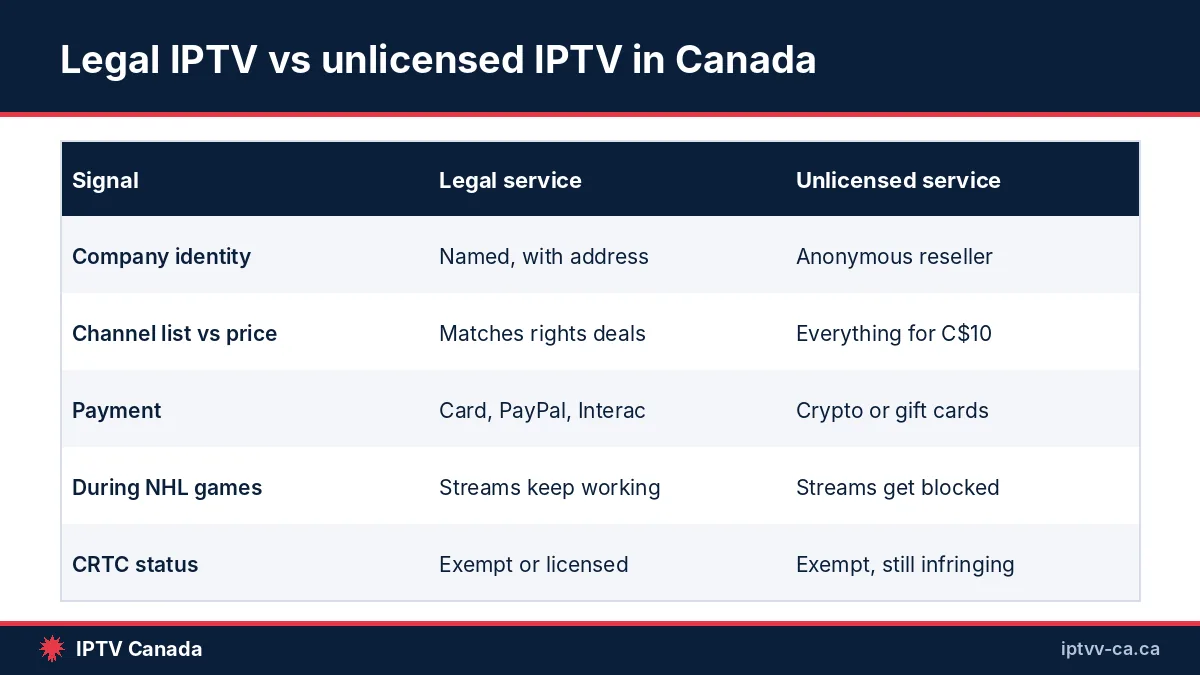
No Canadian registry lists “approved” IPTV services, so you have to assess each one yourself. The points below are drawn from the factors in section 27(2.4) of the Copyright Act and from the facts courts relied on in GoldTV, Lackman and the NHL cases. Two or three red flags together are usually enough.
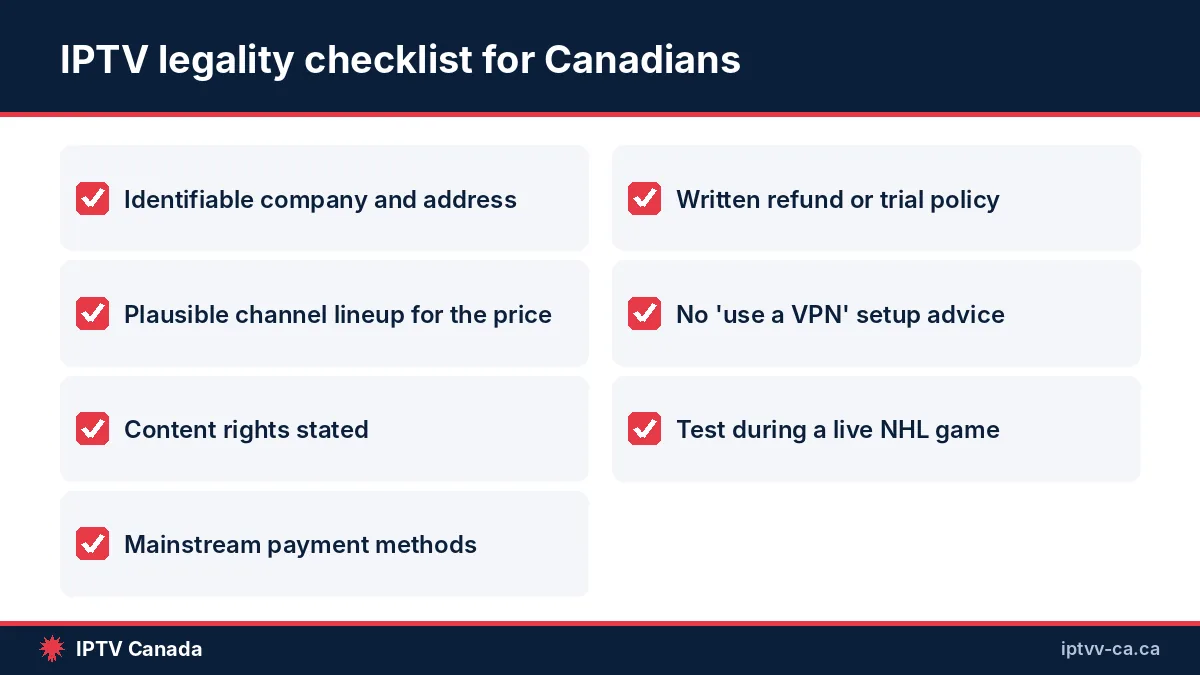
Legality checklist for any IPTV service
- Identifiable company. A legal business name, a physical address, a privacy policy and terms of service. Anonymous Telegram-only sellers fail this test.
- Plausible channel lineup. Sportsnet, TSN, RDS, HBO, every U.S. regional sports network and every PPV event for under C$20 is not a licensing arrangement any broadcaster has ever signed.
- Stated rights. Licensed services name their content partners or hold their own broadcasting rights. “We aggregate publicly available streams” is a warning sign.
- Official app distribution. A presence on the App Store, Google Play, Amazon Appstore or Roku Channel Store means the vendor passed at least a basic review.
- Normal payment rails. Card processors and PayPal shut down accounts flagged for piracy, so a service that accepts only cryptocurrency or gift cards is telling you something.
- Refund and trial terms in writing. A published money-back policy with a support contact signals a business that expects to exist next month.
- No “VPN required” advice. If the setup guide says to use a VPN “so your ISP does not block it,” the service is already subject to a Federal Court order.
A ten-minute due-diligence routine
- Open the provider’s website and look for a legal entity name, address and contact page. A WHOIS lookup shows whether the domain was registered last month.
- Read the channel list against the price. Count the premium Canadian sports and movie channels promised, then compare with what Sportsnet+ alone costs.
- Search the brand name together with “Federal Court” or “blocked” to see whether it or its predecessors appear in a blocking order or trade reporting.
- Check the payment page. Confirm the merchant name matches the company and that mainstream methods such as Visa, Mastercard, PayPal or Interac e-Transfer are accepted.
- Use the shortest paid option first. A low-cost trial or a one-month plan limits your loss if the service fails any later test.
- Test during a live Canadian NHL game. If streams for that game fail while everything else works, you are likely watching dynamic blocking in action, the clearest real-world signal of an unlicensed service.
Our own 24-hour IPTV trial for C$1.99 exists partly for step five: it runs on the same servers as the paid plans, so what you see is what you get. We would rather you test and leave than prepay a year on faith, and that standard should apply to every provider.
What does the CRTC regulate, and what does it not police?
Canadians often assume the CRTC decides whether an IPTV service is legal. It does not. The CRTC licenses broadcasting distribution undertakings (cable, satellite and IPTV distributors such as Bell, Rogers, Telus and Vidéotron) and broadcasters under the Broadcasting Act. Copyright is enforced privately by rights holders in the courts, and criminally by police. The CRTC does not investigate pirate IPTV, fine viewers or maintain a blocklist.
The digital media exemption order
Internet-delivered programming has been exempt from CRTC licensing since the 1999 new media exemption, updated by Broadcasting Order CRTC 2012-409 (July 26, 2012), now called the Exemption order for digital media broadcasting undertakings. It covers broadcasting services delivered and accessed over the internet or point-to-point to mobile devices. Its conditions concern fair dealing between companies: no undue preference, no tying programming exclusively to a specific mobile or internet access service, a standstill during disputes and reporting on request. There is no condition about owning the rights to what you stream; that is copyright law’s job.
This is why both Crave and a pirate IPTV service can be “exempt” from CRTC licensing at the same time. The exemption answers “do you need a broadcasting licence?” and says nothing about the Copyright Act. Anyone who tells you a service is “CRTC-approved” is confused or misleading you. In the GoldTV appeal, TekSavvy argued that only the CRTC could authorize blocking under the Telecommunications Act; the Federal Court of Appeal rejected that, confirming that blocking orders flow from the courts’ injunction powers.
What are the common myths about IPTV legality in Canada?
The same claims circulate on Reddit, Facebook Marketplace and reseller websites. Each wraps a grain of truth around a wrong conclusion.
“Streaming is not downloading, so it is not infringement”
The grain of truth: Canadian enforcement against individuals has centred on BitTorrent, where every user also uploads. The wrong conclusion: that streaming unlicensed content is therefore lawful. The Act’s exclusive rights include communication to the public and making available, and the enabler provision covers streaming services. The viewer’s exposure is lower in practice, not zero in law.
“A VPN makes it legal”
A VPN (virtual private network) encrypts your traffic and routes it through another server. It can get around an ISP block, which is why pirate services recommend one, but it changes nothing about the licensing status of the content. VPNs themselves are legal in Canada and have many legitimate privacy uses.
“The box is sold openly, so the service must be fine”
Fire TV Sticks, Android boxes and generic player apps are lawful. Courts drew the line at boxes pre-loaded with infringing add-ons (iTVBox) and at repositories that curated them (TVAddons). Hardware being sold on Amazon.ca tells you nothing about the subscription someone sells you to put on it.
“Nobody has ever been charged, so there is no risk”
True for viewers as far as the public record shows; false for sellers, as the Halifax RCMP charges demonstrate. And the absence of viewer prosecutions does not protect you from a prepaid subscription that dies when the Federal Court adds the service to a dynamic order, or from an operator with no legal address to pursue if something goes wrong.
How can you use IPTV responsibly in Canada?
Responsible use starts with being honest about what you are buying. Canada’s licensed options are expensive, especially for sports, and the gap between roughly C$345 a year for Sportsnet+ Premium and C$90.99 a year for a multi-channel IPTV plan is why this market exists. We recommend making that decision with the facts in this article in front of you, not on a reseller’s claim that “everything is legal in Canada.”
Second, protect yourself as a consumer whichever service you choose. Never prepay a year with a provider you have not trialled, pay with a method that offers dispute rights (a credit card or PayPal) rather than cryptocurrency, and install player apps from official stores where possible.
Third, blocking orders affect your viewing, not just the operator’s business. During a Canadian NHL game, ISPs block IP addresses in near real time; if a service’s hockey streams freeze while its news channels keep running, that is the order working as designed. Since the 2026 expanded-scope order, rebranded services inherit their predecessors’ blocks.
Fourth, know your lawful alternatives for what you actually watch. Many Canadians buy a pirate package for three channels. If those are CBC, a local news station and one sports feed, CBC Gem (free with ads), an over-the-air antenna and a single sports subscription may cost less than you assume. Our guide to which channels Canadian IPTV packages include helps you map what you watch against what each option carries.
Where IPTV Canada fits
IPTV Canada’s plans start at C$20.99 for one month on one device, with 3-, 6- and 12-month options (C$41.99, C$55.99 and C$90.99) paid once with no auto-renewal. Payment is in CAD by Visa, Mastercard, Amex, PayPal, Apple Pay, Google Pay or Interac e-Transfer, support is a real person on WhatsApp 24/7, and there is a 7-day money-back guarantee. Full plan details are on our IPTV subscription page for Canada. We ask that you apply the checklist from this article to us as to anyone else, and that you start with the C$1.99 trial rather than a long plan.
What has not changed, as of October 2026, is the basic legal structure. There is no “viewer offence” specific to IPTV, notice-and-notice cannot carry a payment demand, and non-commercial statutory damages remain capped at C$5,000. If Parliament amends the Copyright Act again, or a rights holder tests a subscriber-level claim in court, this article will be updated. Until then, the sensible reading is the one we opened with: the technology is legal, unlicensed content is not, and the difference is yours to check.
Frequently asked questions
Is IPTV illegal in Canada?
No. IPTV is a delivery technology used by Bell Fibe TV, Telus Optik TV, Rogers Ignite TV and the broadcasters’ own apps. What is unlawful is streaming channels or films without a licence from the rights holder. The Copyright Act targets services built primarily to enable infringement, and the Federal Court has ordered ISPs to block such services since 2019. Legality depends on whether the content is licensed, not on the technology.
Can you get fined for watching IPTV in Canada?
As of October 2026 there is no reported Canadian case of a viewer being fined or prosecuted solely for watching an unlicensed IPTV service; enforcement has targeted operators, resellers and box sellers. In law, however, a viewer could face non-commercial statutory damages of C$100 to C$5,000 under section 38.1 of the Copyright Act if sued, so the absence of cases is not a legal exemption.
What does the Copyright Act say about IPTV streaming in Canada?
Section 27(1) makes it an infringement to do anything only the copyright owner may do, including communicating a work to the public. Section 27(2.3) makes it an infringement to provide an internet service primarily for enabling infringement, and section 27(2.4) lists factors such as how the service is marketed and whether it would be viable without infringement. Section 42 adds criminal penalties for commercial-scale infringement, up to C$1,000,000 and five years on indictment.
Does using a VPN make IPTV legal in Canada?
No. A VPN is legal and useful for privacy, but it only hides your traffic and can bypass ISP blocking. It does not change whether the service you reach has licensed its content. If a provider says a VPN is needed because Canadian ISPs block it, that usually means the service is already subject to a Federal Court blocking order, which is strong evidence it is unlicensed.
Does the CRTC regulate or approve IPTV services?
The CRTC licenses cable, satellite and IPTV distributors such as Bell, Rogers, Telus and Vidéotron, but internet-delivered streaming services are exempt from licensing under Broadcasting Order CRTC 2012-409. That exemption concerns broadcasting licences only and says nothing about copyright. The CRTC does not approve, investigate or block streaming services, so no service can honestly call itself CRTC-approved.
Which IPTV services are legal in Canada?
Clearly legal examples include Bell Fibe TV, Telus Optik TV, Rogers Ignite TV, Vidéotron Helix, Sportsnet+, TSN+, RDS, Crave and CBC Gem, because the operator either holds the Canadian rights or is a licensed distributor. For any other provider, check for an identifiable company, a plausible channel lineup for the price, stated content rights, mainstream payment methods and a written refund policy before subscribing.
What is the GoldTV case and why does it matter?
GoldTV was a pirate IPTV service sued by Bell Media, Groupe TVA and Rogers Media. In Bell Media v. GoldTV, 2019 FC 1432, the Federal Court issued Canada’s first order requiring major ISPs to block a website, and the Federal Court of Appeal upheld it in 2021 FCA 100. It established that Canadian courts can order site blocking without CRTC involvement and opened the door to the dynamic NHL, NBA and Premier League blocking orders.
Sources
- Copyright Act, R.S.C. 1985, c. C-42, s. 27 (infringement, enabler provision) — Department of Justice Canada (accessed October 2026)
- Copyright Act, s. 38.1 (statutory damages) — Department of Justice Canada (accessed October 2026)
- Copyright Act, s. 41.26 (notice-and-notice obligations of ISPs) — Department of Justice Canada (accessed October 2026)
- Federal Court of Appeal upholds Canada’s first anti-piracy site-blocking order (Teksavvy v. Bell Media, 2021 FCA 100) — Smart & Biggar (accessed October 2026)
- Kodi box add-on distributor loses copyright appeal: Bell v. Lackman, 2018 FCA 42 — Barry Sookman (accessed October 2026)
- Federal Court grants dynamic site-blocking order to address piracy of live NHL broadcasts (Rogers Media v. John Doe 1, 2022 FC 775) — Canadian Lawyer (accessed October 2026)
- Federal Court grants site-blocking order against pirate NHL, NBA, Premier League live streams — The Wire Report (accessed October 2026)
- Federal Court ruling streamlines blocking of pirate TV and live sports domains (T-1127-26) — Broadcast Dialogue (accessed October 2026)
- Broadcasting Order CRTC 2012-409, Exemption order for digital media broadcasting undertakings — CRTC (accessed October 2026)
- Halifax-area couple face 25 charges related to TV piracy investigation: RCMP — Global News (accessed October 2026)
- Film, TV studios filing lawsuits against Canadian BitTorrent users — CBC News (accessed October 2026)
- Sportsnet+ prices just went up in Canada ahead of the NHL season — iPhone in Canada (accessed October 2026)
Get the next IPTV guide by email
New setup guides, app comparisons and buffering fixes for Canadian viewers – about two emails a month, no spam, unsubscribe in one click.