
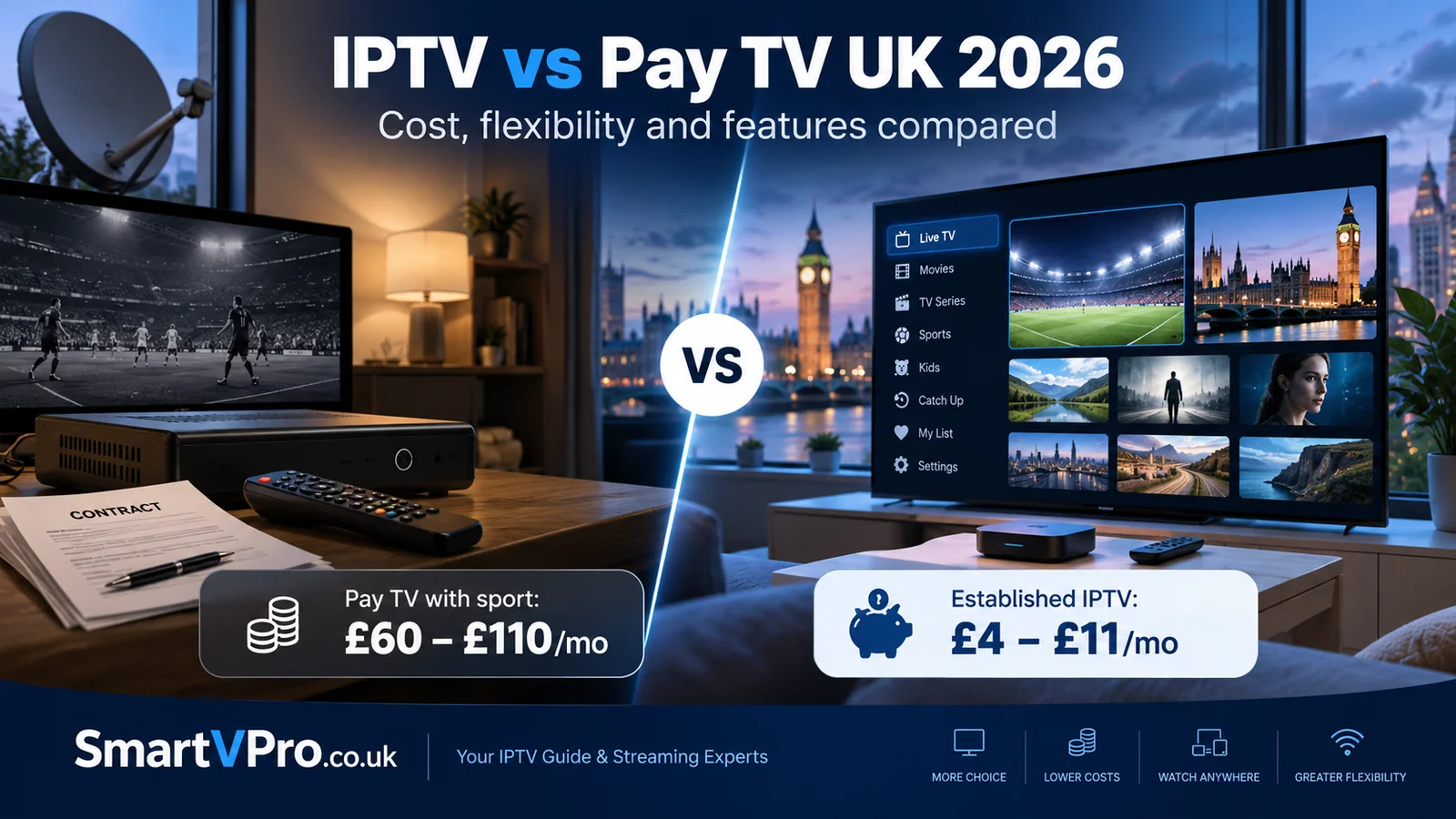
Canadians pay some of the highest television bills in the developed world, and the question behind most searches for “IPTV vs cable” is simple: can I drop the C$120-a-month package without losing hockey? This comparison puts cable, satellite, telecom fibre TV, streaming-app bundles and independent IPTV side by side — on cost over two years, on sports, on reliability, on ease of use — and is honest about where cable still wins.
- Over two years, a household with a sports tier typically pays C$2,500–4,000 for cable or satellite and C$170–500 for an independent IPTV subscription on one to two devices.
- Cable and satellite still win on simplicity (one bill, one remote, no dependence on your internet) and on guaranteed local news and community channels.
- IPTV wins on price, on breadth (Canadian, US, French and international channels in one guide), on on-demand depth and on having no contract.
- Streaming-app bundles are excellent for on-demand but fragment live sports across three or four subscriptions.
- The practical path: keep your internet, run a 24-hour IPTV trial at 8 p.m., and only then cancel cable.
IPTV vs pay TV at a glance
| Cable | Satellite | Telecom fibre TV | Streaming apps | Independent IPTV | |
|---|---|---|---|---|---|
| Monthly cost (with sports) | C$100–180 | C$90–160 | C$90–170 | C$40–80 across 3–4 apps | C$7–25 |
| Contract | Often 24 months | Often 24 months | Often 24 months | None | None |
| Equipment | Rented box (C$10–20/mo) | Dish + receiver | Rented box | None | Any device you own |
| Live sports | Full | Full | Full | Partial, split | Canadian + US networks |
| International channels | Theme packs, extra cost | Limited | Limited | Rare | 50+ countries included |
| Needs internet | No | No | Yes | Yes | Yes |
| Local news | Yes | Yes | Yes | Some | Major markets, not every community channel |
The real two-year cost
Headline prices hide the promotional cliff. Most Canadian cable and satellite packages start with a twelve-month promo, then rise by C$20–40 a month. Add the box rental, the sports tier and HST, and the honest two-year figure for a mid-range package with sports is around C$3,000. A telecom fibre TV bundle lands in the same range once the promo ends.
| Option | Year 1 | Year 2 | Two-year total |
|---|---|---|---|
| Cable with sports tier + box rental | ~C$1,400 | ~C$1,700 | ~C$3,100 |
| Satellite with sports | ~C$1,300 | ~C$1,600 | ~C$2,900 |
| Three streaming apps incl. sports | ~C$700 | ~C$750 | ~C$1,450 |
| Independent IPTV, 1 device annual | C$86 | C$86 | C$172 |
| Independent IPTV, 2 devices annual | C$157 | C$157 | C$314 |
The IPTV figures use IPTV Canada’s annual pricing in CAD; other reputable services fall within about 20% of them. Even with a C$70 Fire TV Stick added, the gap is several thousand dollars over two years.
Where cable’s advantages stop — and where they don’t
Cable is not obsolete. A cable box works when your internet is down, it never buffers, it carries every community channel and local newscast in your market, and there is exactly one company to call. For a household that watches mainly local news and a few network shows, and values never thinking about it, cable can be the right answer.
Its advantages stop at price, flexibility and breadth. You cannot add a French sports channel and an Italian news channel for a few dollars; you cannot cancel next month; you cannot watch on your phone at the cottage without a companion app that may or may not carry the channel you want. That is the ground IPTV occupies.
Telecom fibre TV: the IPTV you already pay for
Bell Fibe TV, Telus Optik TV and similar products are, technically, IPTV — television delivered over an internet connection. They prove the technology works at scale in Canada. The differences from an independent service are commercial: a curated Canadian channel list, a rented set-top box, a contract, and a price that behaves like cable’s. If you like the experience but not the bill, an independent IPTV subscription delivers the same technology at a fraction of the cost, with a wider line-up and none of the contract.
Streaming bundles: great for shows, awkward for sports
A stack of streaming apps is the modern default for on-demand — and for a household that does not follow live sports, it may be all you need. The problem is live sport: hockey, football, basketball and soccer rights are split across several Canadian services, each C$15–25 a month, each with its own app and its own login. Three or four of them cost as much as cable did, and you still switch apps to follow one team through a season. Independent IPTV puts the sports networks in one guide.
Sport: where the debate gets loudest
For most Canadian switchers, this is the whole question. Two things to test in any IPTV trial: whether the service carries both the Canadian and US sports networks (and the regional hockey feeds, not just the national ones), and whether the stream stays stable at 8 p.m. local time on a game night. Cable’s advantage here is reliability, not coverage. A well-run IPTV service closes that gap; a cheap one does not, which is why the trial matters more for sports households than for anyone else.
Reliability, legitimacy and the fine print
Cable’s reliability is real: no buffering, ever. IPTV depends on your internet and the provider’s capacity. On a decent connection with a reputable provider, the practical difference is small; on congested apartment Wi-Fi with a C$5 reseller, it is large. Legitimacy is a separate question. IPTV as a technology is legal in Canada; what may be viewed depends on rights, and it is your responsibility to make sure you have the right to view the content you access. A provider that publishes a clear disclaimer, a DMCA policy and a real refund policy is telling you something about how it operates.
What happens to your box, dish and recordings
- The rented box goes back — return it promptly to avoid the non-return charge, which can be C$100–300.
- The dish can stay on the wall; nobody will come for it.
- PVR recordings do not transfer. Watch or accept the loss. IPTV catch-up covers the last few days on the main channels, and the on-demand library covers most series.
- Your internet plan stays. If it was bundled, ask the telecom for the internet-only price before cancelling TV; sometimes a lower-tier bundle still beats internet alone.
Switching from cable to IPTV: a practical order of operations
- Confirm your internet speed at 8 p.m. — 25 Mbps or more of steady bandwidth is comfortable.
- Take a 24-hour trial for C$1.99 on your main TV. Watch a full game.
- Check the guide for your time zone and the channels your household actually watches, including French-language ones if needed.
- Buy one month. Live with it for a few weeks alongside cable.
- Cancel cable, return the box, and move to an annual IPTV plan.
How IPTV Canada compares with pay TV
IPTV Canada is an independent IPTV subscription priced in CAD — C$20.99 monthly or C$90.99 annually on one device, up to four devices — with Canadian, US, French-language and international channels, 4K where the source supports it, a 7-day guide with catch-up, WhatsApp support 24/7, Interac e-Transfer accepted, no contract and a 7-day money-back guarantee. It will not replace the peace of mind of a cable box for someone who never wants to think about their internet. For everyone else, the numbers above are the argument.
Run the comparison on your own TV: a full game, every channel, 24 hours for C$1.99.
IPTV vs cable in Canada: FAQ
Is IPTV cheaper than cable in Canada?
Substantially. A cable or satellite package with sports typically costs C$100–180 a month plus box rental, while a reputable IPTV subscription is C$7–25 a month depending on term and device count. Over two years the difference is usually several thousand dollars.
Can I get hockey on IPTV?
Reputable Canadian-ready services carry the Canadian and US sports networks, including regional hockey feeds, in HD and 4K. Test a live game during a trial to confirm coverage and peak-time stability.
Will I lose local news if I switch?
Major-market local newscasts are generally available; small community channels may not be. Check during the trial if a specific local channel matters to you.
Does IPTV work if my internet goes down?
No — that is cable’s one structural advantage. IPTV needs a working internet connection, so households with unreliable internet should weigh that.
Can I keep cable and add IPTV?
Yes, and it is a sensible way to switch: run both for a month, then cancel cable once IPTV has proven itself on game nights.
Is IPTV legal in Canada?
The technology is legal and is what major telecoms use for their own TV services. Which content may be viewed depends on rights; it is your responsibility to make sure you have the right to view what you access. See our disclaimer.
Get the next IPTV guide by email
New setup guides, app comparisons and buffering fixes for Canadian viewers – about two emails a month, no spam, unsubscribe in one click.